What Is Finland’s Sand Battery (and How Does It Store Solar Energy)?
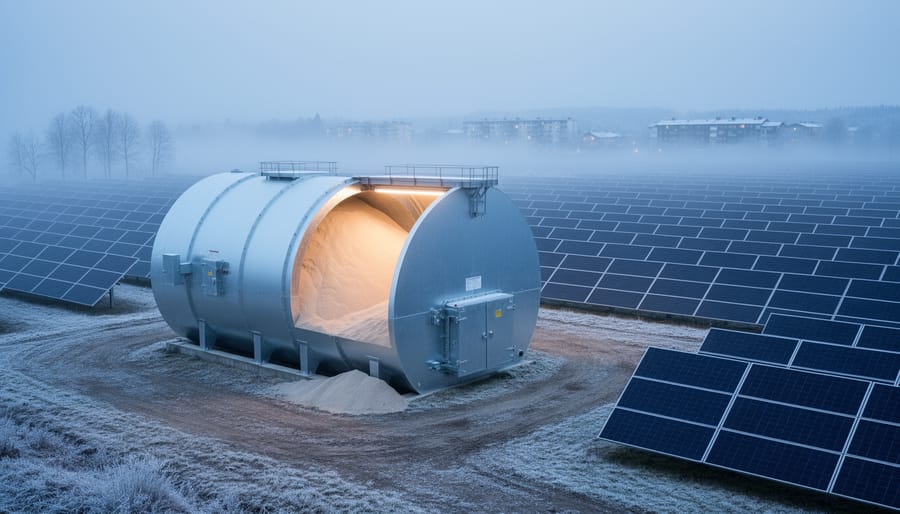
A sand battery is a thermal energy storage system that uses sand or sand-like materials as a medium to store heat at temperatures ranging from 500°C to over 1000°C for weeks or months. This technology captures excess renewable electricity, converts it to heat through resistive heating, and stores it in insulated containers filled with low-cost material like construction-grade sand. The stored thermal energy can then be released on demand for district heating, industrial processes, or, in emerging applications, converted back to electricity.
Finland has emerged as the proving ground for commercial sand battery deployment. Polar Night Energy and Valkeakosken Energia launched the Sand to Power Pilot in Valkeakoski in 2025, a €4.2 million research program running through 2027 that’s testing a system capable of converting stored heat back into electricity through a Power-to-Heat-to-Power cycle. This pilot, backed by a €2.1 million grant from Business Finland, represents a significant step beyond the district heating applications sand batteries were originally designed for.
For solar energy professionals, sand batteries address a persistent challenge in high-latitude climates: the dramatic seasonal mismatch between solar generation and heating demand. Finland receives abundant daylight during summer months but faces near-total darkness in winter when energy needs peak. Traditional lithium-ion batteries handle daily or weekly cycling efficiently but become prohibitively expensive for the multi-month storage required to shift summer solar abundance to winter heating loads. Sand batteries offer a cost-effective alternative for seasonal thermal storage, potentially enabling solar installations in Nordic regions to deliver value year-round rather than exporting excess summer generation at depressed prices or curtailing output entirely.
What a Sand Battery Is: Thermal Storage Using Sand

A sand battery is a thermal energy storage system that captures and holds heat in sand rather than storing electricity in chemical form. Unlike lithium-ion batteries, which use electrochemical reactions to store and release electrical energy, a sand battery converts excess electricity into heat through resistive heating elements, then retains that thermal energy in a mass of sand until it’s needed. The system doesn’t store electrons or charge; it stores warmth, which can later be extracted to heat buildings or, in newer designs like the Valkeakoski pilot, converted back into electricity through Power-to-Heat-to-Power technology.
Sand works exceptionally well as a thermal storage medium for several practical reasons. First, sand’s high thermal stability allows it to maintain elevated temperatures for weeks or even months when properly insulated, making it ideal for seasonal storage applications. Second, sand is abundant, non-toxic, and inexpensive compared to the rare earth metals and lithium compounds required for electrochemical batteries. Third, sand doesn’t degrade through charge cycles the way chemical batteries do; it can be heated and cooled repeatedly without losing its storage capacity.
The operational simplicity of sand-based thermal storage also reduces maintenance requirements and system complexity. There are no electrolytes to manage, no thermal runaway risks, and no concerns about depth-of-discharge limitations. For applications like district heating in Nordic countries, where winter demand for thermal energy far exceeds summer needs, sand batteries offer a straightforward way to capture summer solar surplus and hold it until the heating season begins months later.
How Sand Battery Technology Works
Energy Input and Heat Generation
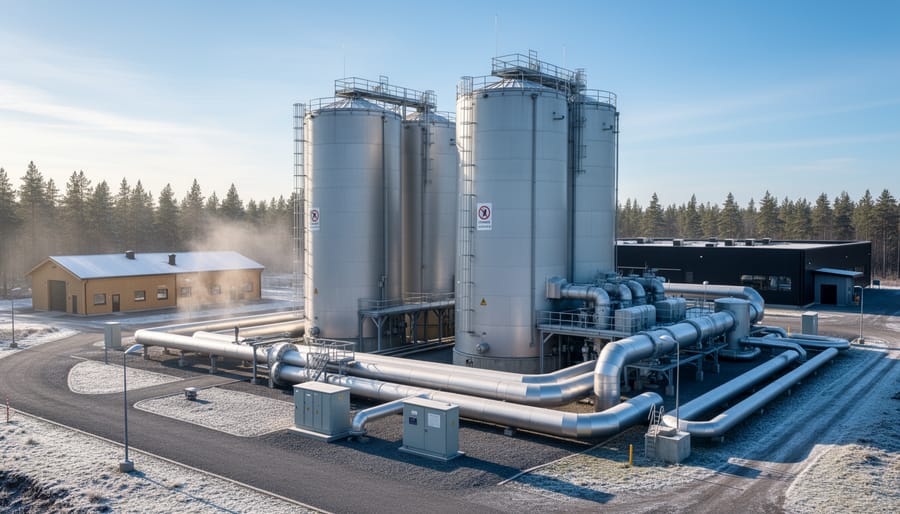
When renewable generation exceeds immediate grid demand, sand battery systems capture this surplus through resistive heating elements embedded within the sand medium. Excess electricity from solar arrays during long summer days or wind farms during high-output periods flows directly into these heating elements, which convert electrical energy into thermal energy with minimal conversion loss.
The process resembles a scaled-up version of a household electric heater. Electricity passes through resistive coils that reach temperatures of 500-600°C, radiating heat into the surrounding sand. Because sand particles conduct and distribute heat efficiently throughout the storage mass, the entire silo reaches uniform high temperatures over several hours of charging.
This approach solves a critical renewable energy challenge: what to do with clean electricity when production outstrips consumption. Rather than curtailing solar or wind generation, the sand battery absorbs excess output as stored heat, effectively shifting energy availability from periods of abundance to times of scarcity without requiring expensive electrochemical batteries.
Heat Retention and Insulation
Sand’s effectiveness as a thermal storage medium stems from its high volumetric heat capacity and exceptionally low thermal conductivity. When heated to temperatures between 500°C and 1,000°C, sand retains energy for weeks or months with minimal loss. The material’s granular structure creates countless air pockets that slow heat transfer, functioning as built-in insulation at the microscopic level.
Modern sand battery systems use multi-layered insulation strategies. Industrial-grade mineral wool or ceramic fiber blankets surround the storage silo, creating thermal barriers that can reduce heat loss to just 1-3% per month. Some designs incorporate vacuum-insulated panels in critical zones where heat escape would be most problematic, such as pipe penetrations and access points.
The storage vessel itself matters significantly. Steel silos with proper sealing prevent moisture infiltration, which would degrade thermal performance. Larger systems benefit from the square-cube law: as volume increases, the surface-area-to-volume ratio decreases, meaning proportionally less heat escapes through the walls. A 100-ton sand battery loses heat more slowly than a 10-ton unit, making larger installations inherently more efficient for long-duration storage.
Energy Output: From Heat to Power
The Valkeakoski pilot tests P2H2P functionality a significant advance beyond simple district heating applications. In a Power-to-Heat-to-Power cycle, stored thermal energy drives a heat engine or turbine to generate electricity on demand. This conversion introduces efficiency losses compared to electrochemical batteries, since thermal-to-electric conversion typically recovers 30-40% of the stored heat as usable power. However, the economics shift when you consider sand’s negligible material cost and the ability to store gigawatt-hours of thermal energy at far lower capital expense than lithium-ion equivalents. For solar operators in northern climates, P2H2P creates a pathway to monetize summer generation surplus during winter peaks, when wholesale electricity prices climb. The technology remains experimental, but proving this capability would position sand batteries as dual-function assets that provide both heating services and grid-balancing power, filling distinct roles within a diversified storage portfolio.
Sand Battery Components and System Architecture
A sand battery system consists of several interconnected components that work together to capture, store, and release thermal energy. While the core concept is straightforward, the engineering behind large-scale thermal storage requires careful integration of mechanical, electrical, and thermal systems.
The primary components include:
- Storage silo
- A large insulated container filled with sand that serves as the thermal mass, typically constructed from steel or concrete and designed to withstand temperatures exceeding 500°C.
- Resistive heating element
- Electrical coils embedded in the sand that convert surplus electricity into heat through resistance, similar to how an electric stove operates but at industrial scale.
- Thermal insulation
- Multiple layers of heat-resistant materials surrounding the storage silo that minimize heat loss over weeks or months, enabling seasonal energy storage.
- Heat exchanger
- A device that transfers stored thermal energy from the sand to a working fluid, typically water or air, for distribution to end users.
- District heating network
- A system of insulated pipes that carries hot water from the sand battery to buildings for space heating and domestic hot water needs.
- P2H2P converter
- Experimental technology being tested in the Valkeakoski pilot that converts stored heat back into electricity, expanding sand battery applications beyond heating alone.
Control systems monitor temperature gradients throughout the sand mass and regulate energy input and output based on grid conditions and demand. These automated systems determine when to charge the battery with excess renewable energy and when to discharge stored heat.
Scalability represents a key design advantage. Modular construction allows operators to expand storage capacity by adding silos rather than replacing entire systems. The Valkeakoski project will test whether smaller distributed units or larger centralized facilities prove more practical for grid integration. Component standardization across projects could reduce costs as the technology matures.
How Sand Batteries Complement Solar Energy in Northern Climates
Finland’s location at 60°N creates a severe mismatch between solar energy supply and demand. Solar panels generate their peak output during the endless summer days, Helsinki receives nearly 19 hours of daylight at the solstice, but heating requirements plummet when homes need it least. Winter reverses the equation: energy demand for heating surges precisely when solar production drops to a trickle, with some December days offering fewer than six hours of weak sunlight.
Sand batteries address this six-month temporal gap by storing thermal energy across seasons rather than hours. Excess solar generation from May through August, when panels produce far more electricity than the grid can immediately use, gets converted to heat and deposited in sand silos. That stored thermal energy remains available throughout the dark winter months, when heating systems draw from the reserve. The approach transforms what would otherwise be curtailed solar power into a resource that directly offsets fossil fuel consumption during peak heating season.
This seasonal storage capability offers distinct advantages for solar integration in high-latitude climates:
- Long-duration storage measured in months, not the hours typical of lithium-ion systems
- Minimal energy loss over extended periods due to sand’s natural heat retention
- Cost-effective scaling using abundant, inexpensive materials
- No reliance on rare earth elements or complex supply chains
- Direct compatibility with existing district heating networks across Nordic cities
The expanding Europe solar PV market makes this storage approach increasingly relevant. As northern countries add solar capacity, they face growing volumes of summer surplus that conventional batteries cannot economically store for winter use. Sand batteries create a viable outlet for that excess generation.
Wind energy plays a complementary role in these energy storage collaborations. Finland’s wind farms generate more consistently through winter darkness than solar panels, and any surplus wind power can likewise charge the thermal storage system. The combination creates year-round renewable input for a storage technology designed specifically to bridge seasonal gaps, precisely the challenge that high-latitude solar installations face.
Real-World Application: The Valkeakoski Sand to Power Pilot
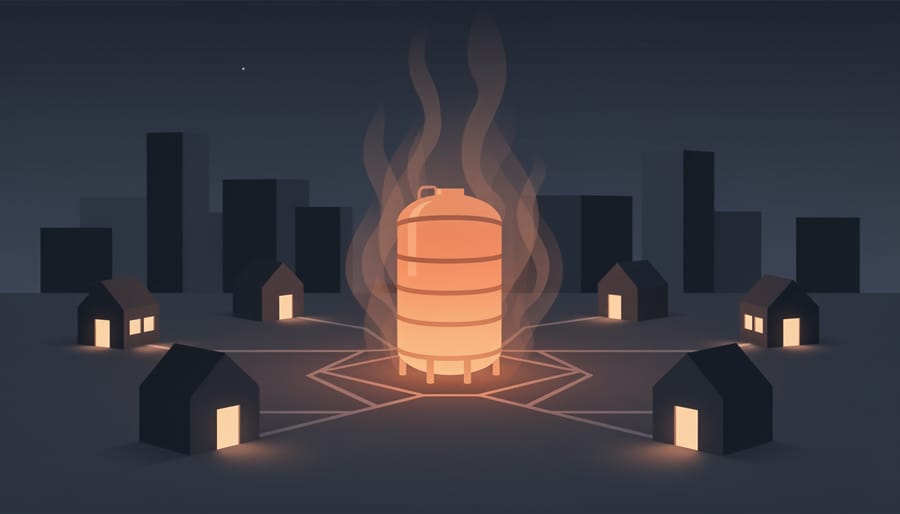
The Valkeakoski Sand to Power Pilot represents a critical test of whether sand battery technology can move beyond district heating into electricity generation. Polar Night Energy and Valkeakosken Energia launched this collaboration in 2025, with construction starts autumn 2025 and operations planned through 2027.
The €4.2 million R&D program, supported by a €2.1 million grant from Business Finland, focuses on developing and proving the Power-to-Heat-to-Power (P2H2P) conversion process. This advancement matters because existing sand battery installations only release stored thermal energy as heat for district heating networks. The Valkeakoski pilot will test whether stored heat can be efficiently converted back into electricity when the grid needs it most.
For solar energy systems in northern climates, this capability addresses a fundamental mismatch. Solar panels generate peak output during Finland’s long summer days, but electricity demand and heating loads spike during the dark winter months. Current sand batteries can already store summer solar surplus and release it as winter heat. If the pilot succeeds in demonstrating viable electricity generation from stored thermal energy, sand batteries would provide a dual-function storage solution that bridges both the seasonal solar generation gap and short-term grid balancing needs.
The project’s significance extends beyond Finland. Many regions with high renewable penetration face similar storage challenges, particularly where solar panel lifespan and output patterns don’t align with energy demand cycles. The Valkeakoski pilot will generate operational data on P2H2P efficiency, cost per kilowatt-hour stored and retrieved, and system reliability over seasonal cycles. These metrics will determine whether sand batteries can complement lithium-ion installations for long-duration storage applications that exceed electrochemical batteries’ economic and technical sweet spot of four to eight hours.
Common Questions About Sand Battery Technology
Can sand batteries store solar power for months?
Yes, sand batteries can retain heat for extended periods when properly insulated. The thermal properties of sand combined with effective insulation allow stored heat to persist across seasonal gaps, making them suitable for storing summer solar excess for winter use in high-latitude climates.
How efficient are sand batteries compared to lithium-ion batteries?
Sand batteries serve a different purpose than lithium-ion systems. While lithium-ion batteries excel at rapid charge-discharge cycles with round-trip efficiencies of 85-95%, sand batteries prioritize long-duration thermal storage at lower cost. The Power-to-Heat conversion is highly efficient, but the experimental Heat-to-Power step being tested in Valkeakoski will determine overall P2H2P efficiency.
Are sand batteries economically viable at small scales?
Current sand battery deployments focus on district heating and community-scale applications rather than residential use. The economics favor larger installations where thermal mass and insulation costs can be amortized across substantial storage capacity, making them more practical as a collective power storage initiative than for individual households.
What is the expected lifespan of a sand battery system?
Sand itself is an inert material that doesn’t degrade, giving sand batteries a theoretical operational lifespan measured in decades rather than years. The limiting factors are the heating elements, insulation materials, and control systems, which require standard industrial maintenance but avoid the capacity fade and replacement cycles associated with electrochemical batteries.
Environmental impact considerations also distinguish sand batteries from conventional storage technologies. The primary material is ordinary sand, an abundant resource with minimal extraction concerns compared to lithium, cobalt, or rare earth elements. There are no toxic chemicals, fire risks, or hazardous disposal requirements. The main environmental consideration is the energy source used for initial heating, which is why integration with renewable solar and wind generation makes sand batteries particularly attractive for decarbonization goals.
Globally, sand battery deployment remains in early stages. Finland leads with operational systems and the ongoing Valkeakoski pilot testing electricity generation capability, but the technology has not yet achieved widespread international adoption. Cost per kilowatt-hour for thermal storage is substantially lower than electrochemical alternatives, but the inability to directly power electrical loads without conversion equipment has limited applications. The success of the 2025-2027 Sand to Power Pilot project will determine whether heat-to-electricity conversion can unlock broader market opportunities beyond district heating networks.
Sand battery technology represents a pragmatic complement to electrochemical storage rather than a replacement, addressing challenges that lithium-ion systems cannot economically solve. For solar energy in seasonal climates like Finland’s, where summer generation vastly exceeds winter output, thermal storage in sand provides a bridge across months-long gaps that would require prohibitively expensive battery installations. The technology excels at what it was designed to do: store large quantities of low-grade heat inexpensively and release it when needed.
The Valkeakoski pilot’s significance extends beyond its immediate €4.2 million scope. If the Power-to-Heat-to-Power conversion proves efficient and scalable during the 2025-2027 testing period, sand batteries could shift from niche district heating applications to broader grid support roles. This capability would make the technology relevant to renewable systems worldwide facing temporal mismatches between generation and demand.
The success or failure of this pilot demands rigorous independent coverage. As renewable energy systems grow more complex, accurate reporting on emerging storage technologies becomes essential for informed infrastructure decisions. Journalists and industry professionals must distinguish between proven capabilities and promotional claims, ensuring that innovations like sand batteries are evaluated on performance data rather than optimistic projections. The renewable energy sector benefits most when new technologies face transparent scrutiny alongside traditional coverage of established solutions.