What Is Joule Solar Energy (and How Does It Work)?
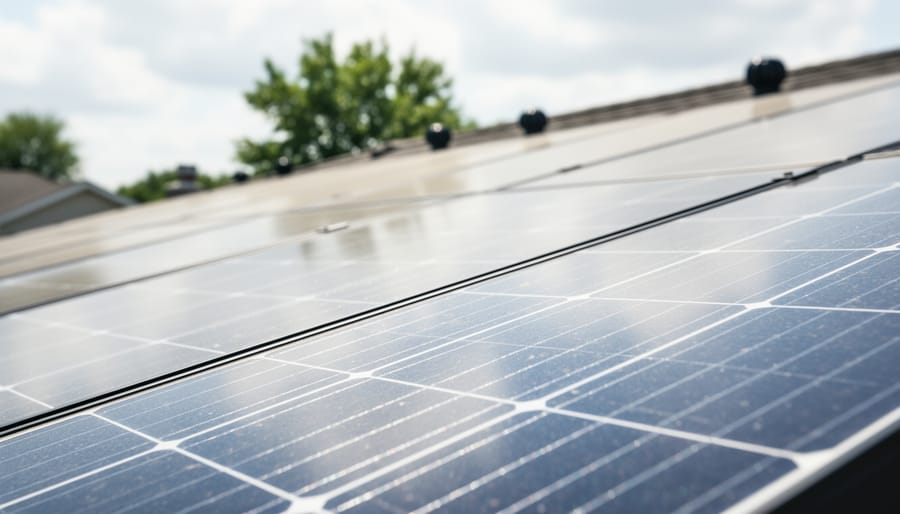
A joule is the standard unit of energy measurement in solar photovoltaic systems, quantifying the amount of electrical work generated by converting sunlight into usable power. One joule represents the energy transferred when one watt of power is sustained for one second, making it the fundamental metric for assessing how efficiently solar panels capture and convert solar radiation into electricity.
Understanding joule measurements matters because these values directly reveal system performance and equipment health over time. Solar professionals rely on joule-based metrics to track energy output degradation, compare panel efficiency across different conditions, and predict when components require maintenance or replacement. While consumers typically see energy measured in kilowatt-hours on their utility bills, the underlying joule calculations drive critical decisions about system sizing, warranty claims, and return on investment.
This article explains how joules function as the foundation of solar energy measurement, breaking down the conversion process from photon absorption to electrical output. You’ll learn which system components influence joule production, how measurement tools quantify energy flow in real time, and why tracking cumulative joule output over months and years provides the most reliable indicator of solar equipment longevity. For both new installations and aging systems, joule-level analysis separates genuinely efficient equipment from underperforming arrays that drain long-term value.
What Joule Solar Energy Means
A joule represents the fundamental unit of energy in the International System of Units, and in solar installations it quantifies the actual energy your panels produce and your system stores. Named after physicist James Prescott Joule, one joule equals the energy transferred when one watt of power flows for one second, a tiny amount in practical terms, which is why solar professionals typically work with larger units for real-world calculations.
- Joule
- The SI base unit of energy, representing the work done when one watt of power is applied for one second. In solar systems, billions of joules accumulate over time to represent meaningful energy production.
- Watt
- A unit of power measuring the rate of energy flow, where one watt equals one joule per second. Solar panels are rated in watts to indicate their instantaneous power generation capacity.
- Kilowatt-hour
- The standard billing unit for electricity, where one kilowatt-hour equals joules totaling 3.6 million, the energy delivered by 1,000 watts running for one hour.
- Energy Conversion
- The process of transforming solar radiation into measurable electrical energy, expressed in joules as photons strike panel surfaces and generate electron flow through the photovoltaic effect.
The relationship between these units matters because your utility bill shows kilowatt-hours while your system’s instantaneous output appears in watts, yet the underlying physics operates in joules. A 400-watt panel producing at full capacity for one hour generates 400 watt-hours (0.4 kilowatt-hours), which translates to 1.44 million joules of energy. Understanding this conversion chain helps you interpret monitoring data, compare equipment specifications, and calculate actual production against manufacturer ratings.
Solar monitoring systems typically display power in watts or kilowatts and cumulative production in kilowatt-hours because these units align with how we purchase electricity and size installations. The joule remains essential in the background, governing the physics of energy conversion and providing the mathematical foundation for all other measurements you encounter in system performance analysis.
How Joule Measurement Works in Solar Systems
The Photovoltaic Conversion Process
When sunlight strikes a solar cell, photons transfer their energy to electrons in the semiconductor material, typically silicon. Each photon carries a discrete packet of energy measured in joules, approximately 3.0 × 10⁻¹⁹ joules for visible light photons. This energy must exceed the silicon’s bandgap threshold of 1.1 electron volts to dislodge an electron from its atomic bond.
Once freed, these electrons create an electrical imbalance within the cell. The semiconductor is engineered with two distinct layers: an n-type layer with excess electrons and a p-type layer with electron deficiencies. At their junction, an electric field forms naturally. When photon energy liberates electrons, this field pushes them toward the n-type layer while holes migrate to the p-type layer, establishing directional current flow.
Metal contacts on the cell’s front and back capture this electron movement, channeling it into an external circuit. The rate of electron flow determines the current in amperes, while the electric field strength sets the voltage. Multiplying these values yields power in watts, which represents joules per second of energy conversion.
This continuous process transforms roughly 15 to 22 percent of incoming photon energy into usable electrical energy in modern panels, with the remaining energy dissipating as heat.
Energy Measurement and Monitoring
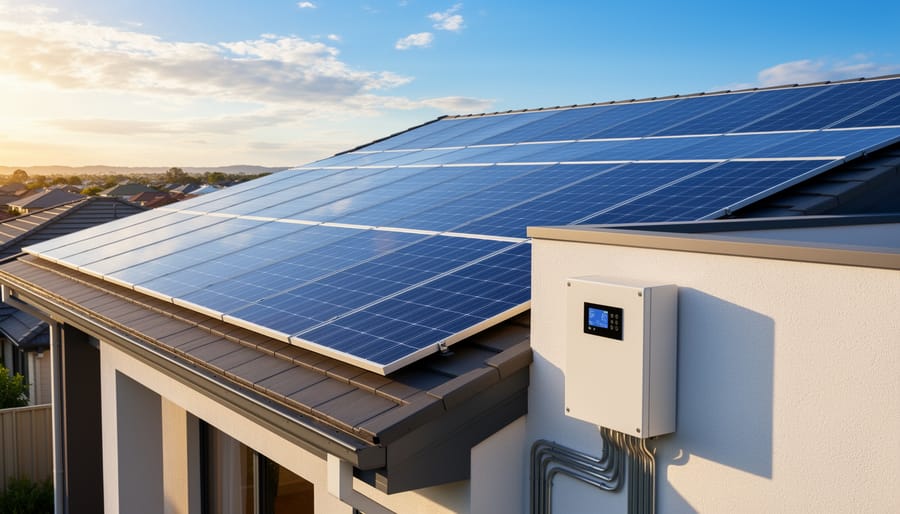
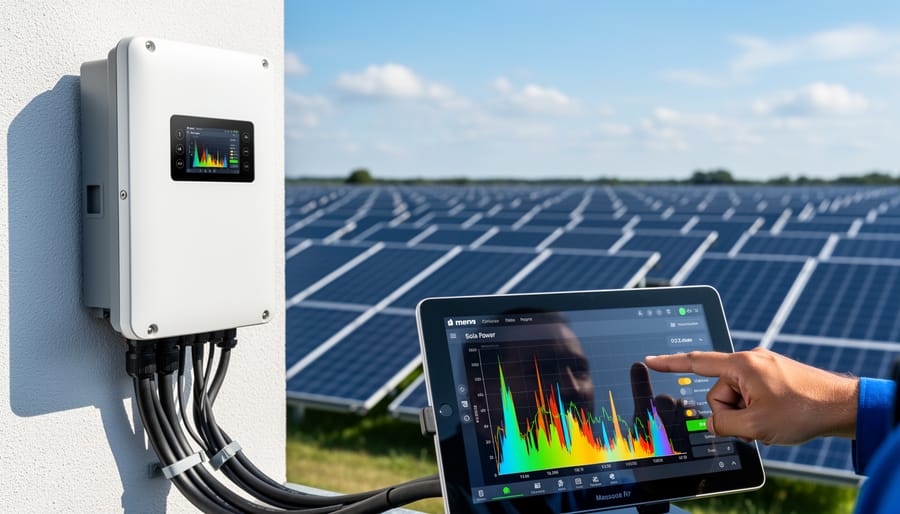
Modern solar installations rely on sophisticated monitoring systems to track energy production with precision. The inverter serves as the central measurement hub, converting DC voltage from panels into AC power while simultaneously recording joules of energy generated each second. These devices capture voltage, current, and power factor data, calculating instantaneous and cumulative energy output in real-time.
Most contemporary inverters transmit performance data to cloud-based platforms through WiFi or cellular connections. These systems log energy production in kilowatt-hours (3.6 million joules per kWh), allowing owners to track daily, monthly, and lifetime generation totals. Advanced monitoring displays granular data including string-level performance, efficiency percentages, and environmental offset metrics.
Data logging systems store historical production records, creating performance baselines that reveal degradation trends over months and years. When output drops below expected thresholds, these systems can alert owners to potential issues ranging from shading problems to solar inverter problems requiring attention.
Some monitoring platforms integrate weather data and irradiance measurements, comparing actual joule production against theoretical maximum output under current conditions. This comparison provides a performance ratio metric, typically expressed as a percentage, that indicates overall system health independent of weather variations.
Components That Influence Joule Output
Panel Technology Variations
Solar panel technology directly impacts joule output through variations in cell structure and light absorption efficiency. Monocrystalline panels deliver 15-22% conversion efficiency under standard test conditions, translating to roughly 150-200 joules per watt-hour of rated capacity. Their uniform silicon crystal structure captures photons more effectively across the solar spectrum, producing consistent joule measurements throughout their operational life. These panels maintain higher output density per square meter, making them ideal for space-constrained installations where maximizing joule production matters.
Polycrystalline panels operate at 13-16% efficiency, generating approximately 130-160 joules per watt-hour. Their multi-crystal composition creates internal boundaries that slightly impede electron flow, reducing total joule output compared to monocrystalline alternatives. However, manufacturing costs run 15-25% lower, and performance gaps narrow in diffuse light conditions. Both crystalline technologies share similar degradation patterns, typically 0.5-0.8% annual decline in joule production, affecting long-term energy yield calculations and solar panel lifespan projections.
Thin-film panels achieve 10-12% efficiency, producing 100-120 joules per watt-hour, but demonstrate unique advantages in high-temperature environments where crystalline efficiency drops. Their broader spectral response captures different wavelength photons, maintaining more stable joule output during morning and evening low-light periods. Temperature coefficients of -0.20% per degree Celsius (versus -0.40% for crystalline) preserve joule production during summer heat, offsetting their lower baseline efficiency in certain climates and applications.
Energy Storage Systems
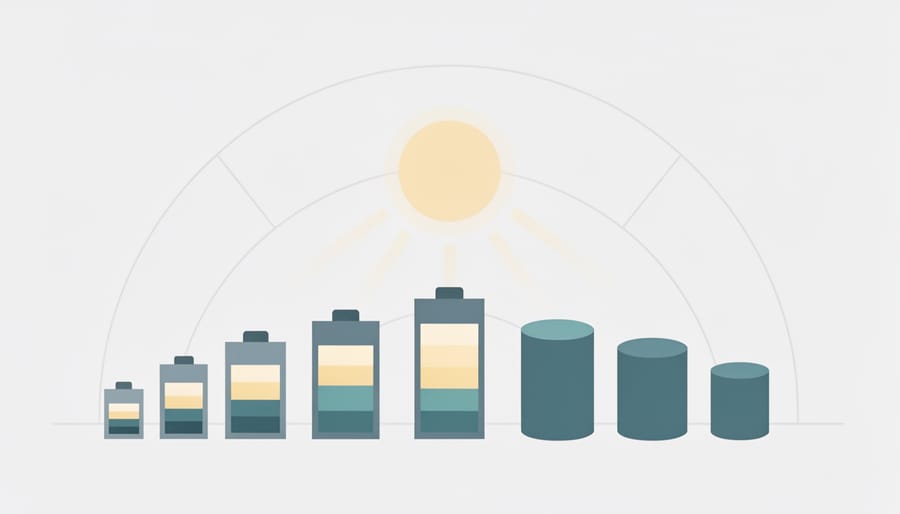
Battery systems function as reservoirs for joules generated by solar panels, converting and storing electrical energy through electrochemical reactions. When panels produce excess energy beyond immediate consumption, charge controllers direct this flow into batteries, where chemical processes transform electrical joules into stored potential energy. The capacity rating, typically expressed in kilowatt-hours (kWh), represents the total joules a battery can store, calculated by multiplying amp-hour capacity by voltage (1 kWh equals 3.6 million joules).
Lithium-ion batteries dominate residential solar storage due to their high energy density and efficiency, typically converting 90-95% of input joules into retrievable energy. Lead-acid alternatives store fewer joules per kilogram but offer lower upfront costs. During discharge cycles, batteries reverse the chemical process, releasing stored joules as electrical current to power loads when panels aren’t producing.
Capacity degradation directly impacts long-term performance. A battery rated at 13.5 kWh initially stores 48.6 million joules, but after 5,000 cycles might retain only 70% of that capacity, reducing available storage to 34 million joules. This degradation accelerates when batteries operate at temperature extremes or undergo frequent deep discharges. Monitoring total joules cycled through the system helps predict when capacity loss will necessitate replacement, typically aligned with photovoltaic lifetime expectations.
Emerging technologies like sand battery storage offer alternative approaches to storing solar joules as thermal energy, though electrochemical systems remain standard for residential applications requiring electrical output.
Joule Metrics in Solar Equipment Longevity Assessment
Performance Degradation Tracking
Tracking joule output provides a precise, quantifiable method for identifying panel performance decline before it becomes critical. Solar panels typically lose 0.5-0.8% of their energy conversion efficiency annually, but this average masks significant variations caused by manufacturing quality, environmental stress, and installation factors. By establishing a baseline joule production rate during the first year and comparing it against subsequent measurements under similar irradiance conditions, system owners can calculate actual degradation over time rather than relying on industry estimates.
Modern monitoring systems record daily, monthly, and annual joule totals, creating degradation curves that reveal whether panels are aging within expected parameters or experiencing accelerated decline. A sudden drop in joule output, beyond normal seasonal variation, may indicate hotspot development, micro-crack formation, or junction box failures that require immediate attention. Systems that maintain detailed joule production logs can also demonstrate compliance with performance warranties, which often guarantee 80-85% of original capacity after 25 years. This translates to specific joule production thresholds that, if not met, trigger warranty claims.
For asset management, degradation tracking informs replacement timing decisions. When cumulative joule decline crosses economic thresholds, where repair costs exceed the value of generated energy, the data supports informed equipment retirement or upgrade decisions, maximizing return on investment across the system’s operational life.
Warranty and Output Guarantees
Manufacturer warranties translate joule output expectations into concrete guarantees that protect your solar investment over time. Most solar panel manufacturers offer two distinct warranty types: a product warranty covering defects (typically 10-15 years) and a performance warranty guaranteeing minimum energy production over 25-30 years.
Performance warranties specify that panels will maintain a certain percentage of their rated capacity, usually 80-85% of original output, after 25 years of operation. In joule terms, a 400-watt panel producing 1,440,000 joules per hour under standard test conditions should still generate at least 1,152,000 joules per hour after two decades. Premium manufacturers now offer linear degradation warranties rather than stepped guarantees, promising gradual decline of 0.25-0.5% annually instead of sudden drops at year 10 or 12.
These guarantees matter because they establish enforceable performance thresholds. If your system’s cumulative joule production falls below the warranted level when adjusted for actual solar irradiance at your location, you have grounds for panel replacement or compensation. However, claiming warranty coverage requires documented performance data. Modern monitoring systems that track total joule output become essential evidence if panels underperform.
Reading warranty fine print reveals crucial exclusions. Most manufacturers void guarantees if you fail to maintain proper system conditions, shading from tree growth, improper installation angles, or electrical mismatches can all reduce joule output without triggering warranty obligations. Some warranties also specify minimum irradiance levels for testing, typically 1,000 watts per square meter, making accurate on-site measurement critical for valid claims.
The strongest warranties combine high retention guarantees (90% at 25 years) with manufacturer financial stability, ensuring the company will honor claims decades from now.
Applications of Joule Measurement in Solar Energy
Understanding joule measurements unlocks practical advantages across every phase of solar energy deployment. From initial planning to decades of operation, these metrics inform critical decisions that directly impact system performance and financial returns.
System designers rely on joule calculations to properly size installations for specific energy needs. By converting a facility’s daily energy consumption from kilowatt-hours to joules, engineers determine the required panel capacity, inverter ratings, and battery storage. A commercial building consuming 500 kWh daily needs a system capable of producing 1.8 billion joules under local irradiance conditions. This precision prevents undersized systems that fail to meet demand or oversized installations that waste capital.
Financial modeling depends heavily on cumulative joule production projections. Investment analysts calculate payback periods and lifetime returns by estimating total joule output over 25-30 years, accounting for degradation rates of 0.5-0.8% annually. A 10 kW residential system producing approximately 13 billion joules annually in moderate climates generates specific revenue streams when multiplied by local electricity rates. These joule-based projections reveal whether installations meet ROI thresholds before construction begins.
Joule metrics serve multiple operational functions across solar installations:
– System sizing: Converting daily consumption to joules ensures accurate capacity planning
– ROI calculation: Lifetime joule production projections determine financial viability and payback timelines
– Performance validation: Comparing actual versus expected joule output identifies underperforming equipment
– Maintenance triggers: Sudden drops in joule production flag cleaning needs or component failures
– Equipment replacement timing: Degradation curves measured in joules guide cost-effective upgrade schedules
– Degradation analysis: Year-over-year joule measurements quantify panel aging rates
Performance monitoring systems use real-time joule tracking to validate warranty guarantees. When manufacturers promise 80% capacity after 25 years, monitoring cumulative joule production provides objective evidence whether panels meet specifications. Utility-scale operators leverage this data in contract negotiations and insurance claims, where a 1% output difference represents significant revenue over decades.
Maintenance teams schedule cleaning and inspections based on joule production trends rather than arbitrary time intervals. A 15% drop in daily joule output compared to baseline triggers immediate investigation, catching issues like soiling, shading, or inverter faults before they compound. This data-driven approach reduces maintenance costs while maximizing uptime across residential rooftop arrays and massive solar farms alike.
Common Questions About Solar Energy Measurement
How do I convert joules to kilowatt-hours for my solar system?
Divide the total joules by 3,600,000 to get kilowatt-hours. For example, 18,000,000 joules equals 5 kWh, which represents a typical daily output for a residential solar panel.
What’s a typical joule output for a single solar panel?
A standard 400-watt residential panel operating at peak conditions for one hour produces approximately 1,440,000 joules (1.44 megajoules). Daily output varies between 4-7 megajoules depending on sunlight availability and panel orientation.
How accurate are joule measurements in solar monitoring systems?
Modern inverter-based monitoring systems measure energy production with 95-98% accuracy. Slight variations occur due to sensor calibration, temperature effects, and conversion losses between DC and AC power.
Does tracking joule output help predict when equipment needs replacement?
Yes. Consistent monitoring reveals degradation patterns, with most panels losing 0.5-0.8% of joule output annually. A panel producing 15% less energy than its rated capacity may warrant inspection or replacement to maintain system efficiency.
Understanding these measurement fundamentals helps you interpret monitoring data correctly and make informed decisions about system maintenance. Most solar owners find that tracking monthly and annual joule totals provides clearer performance trends than daily fluctuations, which can vary significantly due to weather conditions.
When reviewing your system’s energy production, compare actual joule output against your installer’s projections to identify potential issues early. Unexplained drops of 10% or more over a short period often indicate problems with individual panels, wiring connections, or inverter performance rather than normal degradation. Regular monitoring creates a performance baseline that makes these anomalies easier to spot, allowing you to address equipment issues before they significantly impact your long-term energy production and return on investment.
Understanding joule measurement transforms how you evaluate and maintain solar energy systems. Rather than relying solely on vague performance indicators, tracking energy output in joules provides concrete data for assessing panel degradation, predicting equipment lifespan, and optimizing maintenance schedules. This precision matters because solar installations represent significant capital investments with 25-year or longer operational horizons.
When you monitor cumulative joule production alongside rated capacity, you gain early warning of performance decline before it impacts your returns. This measurement approach enables proactive maintenance decisions, validates warranty claims with objective data, and helps you determine the optimal timing for component upgrades or replacements. Financial models become more accurate when built on actual joule output rather than estimated percentages.
For solar professionals and system owners alike, joule metrics offer a universal language for comparing equipment performance across different technologies and installations. Whether you manage a residential rooftop array or oversee utility-scale facilities, the principles remain consistent. Mastering these measurements empowers you to protect your investment, extend equipment life, and maximize energy production throughout your system’s operational lifetime.