How Efficient Homes Lose Energy Through Ducts and Vents: Eligibility for Sealing Programs, How to Address Leaks, and Where to Get Help
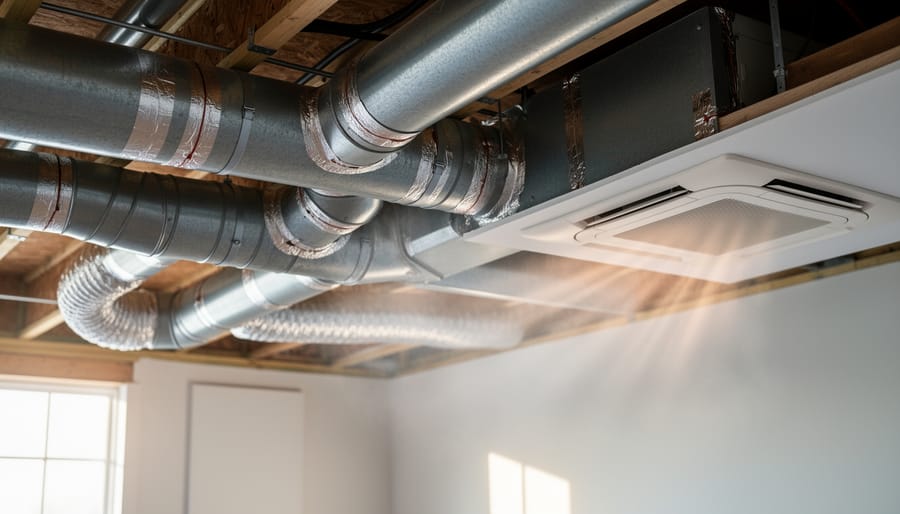
Energy-efficient homes equipped with solar panels, high-performance HVAC systems, and modern insulation routinely lose 20 to 40 percent of conditioned air through leaky ductwork and improperly sealed vents, undermining both energy savings and indoor comfort. The problem isn’t the headline technologies, it’s the hidden distribution network that connects them. Routine inspections by specialists like dryerventcleanexperts.com have documented these issues extensively. A 2025 Lawrence Berkeley National Laboratory study confirmed that even homes meeting stringent ENERGY STAR standards suffer measurable duct leakage, with losses concentrated at poorly sealed joints, boot connections, and return plenums. For solar homeowners especially, this gap represents squandered generation capacity; the kilowatt-hours produced on the roof are effectively vented into attics and crawlspaces before they can offset demand.
The mechanisms are straightforward but often overlooked during construction and retrofit. Supply ducts leak conditioned air into unconditioned zones, forcing HVAC systems to run longer cycles. Return ducts pull in hot attic air or humid crawlspace air, degrading indoor air quality and increasing cooling loads. Dryer vents, bathroom exhausts, and kitchen range hoods compound the issue when improperly installed or maintained. What follows is a technical breakdown of how these losses occur, who qualifies for diagnostic and sealing assistance, the step-by-step remediation process, and where to access certified contractors and utility rebate programs in 2026.
What Duct and Vent Energy Loss Is and Why It Affects Efficient Homes
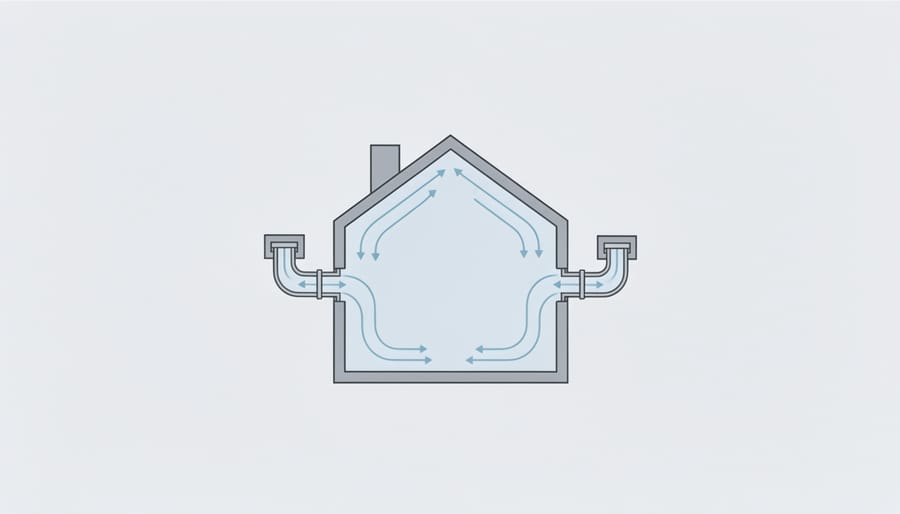
Duct and vent energy loss occurs when heated or cooled air escapes from the distribution system before reaching its intended destination, and when unconditioned air infiltrates through return pathways. In a typical forced-air HVAC system, air travels from the heating or cooling equipment through a network of ducts to supply registers in each room, then returns through separate ductwork. Any gap, crack, or poorly sealed connection along this path allows conditioned air to leak into attics, crawlspaces, basements, and wall cavities, spaces where the energy invested in conditioning that air provides no benefit to occupants.
The physics driving these losses operates through three mechanisms. Air leakage happens when pressure differentials push conditioned air out through gaps in supply ducts or pull unconditioned air in through return duct breaches. Conductive heat transfer occurs when warm or cool air moving through ductwork loses thermal energy through the duct walls themselves, particularly in uninsulated or poorly insulated sections running through unconditioned spaces. Pressure imbalances compound the problem: a leaky return duct creates negative pressure that pulls hot attic air or cold crawlspace air into the living space, while supply leaks generate positive pressure that forces expensive conditioned air into areas you never intended to heat or cool.
Here lies the critical gap in whole-home performance: efficiency ratings assigned to HVAC equipment measure the unit’s ability to convert energy into heating or cooling under laboratory conditions, not its effectiveness at delivering that conditioned air to living spaces. A 95% efficient furnace or 20-SEER air conditioner still wastes substantial energy if 30% of the air it conditions leaks into an attic before reaching the rooms below. Similarly, building envelope efficiency metrics focus on wall, ceiling, and window performance but treat the duct system as separate, even though ducts often represent the largest single source of air leakage in the building shell. For homeowners who invest in solar panels to optimize solar output and offset energy costs, unaddressed duct losses mean those panels work harder to compensate for preventable waste, reducing the financial and environmental return on the entire efficiency investment.
Primary Mechanisms of Energy Loss in Duct and Vent Systems
Air Leakage at Joints, Seams, and Connections
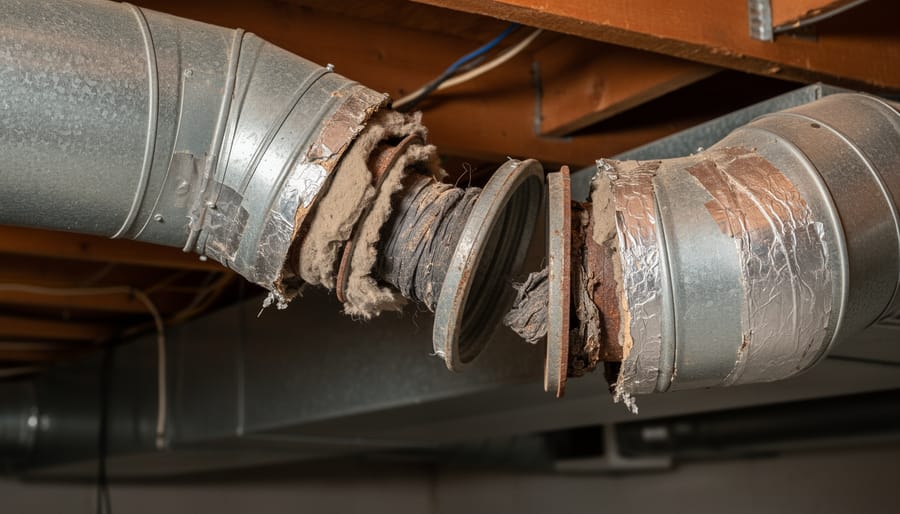
Duct systems fail most often where sections meet. Supply and return joints secured only with standard duct tape deteriorate within months, leaving gaps that leak hundreds of cubic feet per minute into unconditioned spaces. Register boots, the metal boxes connecting ducts to floor or ceiling vents, frequently have visible gaps around their perimeter where drywall or flooring meets the boot edge. These openings dump heated or cooled air directly into wall cavities and attic spaces before it reaches living areas.
Flexible ductwork presents unique vulnerabilities. The inner liner tears at sharp bends, and the plastic vapor barrier separates from the insulation jacket at connection points. Installers often rely on zip ties or plastic clamps that compress the flexible duct onto sheet metal collars, but these connections loosen over time as materials expand and contract with temperature swings.
Rigid sheet metal ducts leak at longitudinal seams and transverse joints where sections telescope together. Plenums, the large boxes that distribute air from the main trunk line to branch ducts, typically have access panels with worn gaskets that no longer seal. Even a quarter-inch gap around a 24-inch square plenum door can leak 40 CFM at typical operating pressures, offsetting gains from a high-SEER air handler.
Conductive Heat Transfer Through Duct Walls
Conductive heat transfer occurs when temperature difference drives thermal energy through the duct wall material itself, even when the duct is perfectly airtight. A supply duct carrying 120°F air through a 40°F attic loses heat continuously through its metal or flex-duct shell to the surrounding cold air. The rate of loss depends on the duct’s surface area, the temperature differential, and the insulation’s thermal resistance.
Building codes typically mandate R-6 or R-8 insulation for ducts in unconditioned spaces like attics, crawlspaces, and garages. Yet field audits consistently reveal R-4 insulation or less, often compressed or poorly fitted around elbows and joints where conductive losses accelerate. Uninsulated sheet metal ductwork, still common in older efficient homes, can lose 25 to 45 percent of delivered thermal energy before air reaches registers.
The shortfall compounds in high-performance homes because efficient HVAC systems run less frequently, giving duct surfaces more time to equilibrate with surrounding temperatures between cycles. When the system restarts, the first minutes of runtime recondition the duct interior rather than the living space. Upgrading to continuous R-8 duct wrap with sealed seams and particular attention to transition sections reduces steady-state conductive losses by 60 to 75 percent compared to code-minimum installations.
Pressure Imbalances and Infiltration
Leaky return ducts create negative pressure inside the conditioned space, actively pulling unconditioned outdoor air through gaps in the building envelope, window frames, electrical penetrations, wall cavities, even in homes with good insulation. This infiltration bypasses filters and ventilation controls, introducing humidity, pollutants, and air that must be heated or cooled from outdoor temperatures. Conversely, supply duct leaks generate positive pressure, forcing expensive conditioned air into attics, crawlspaces, and wall cavities where it provides zero comfort benefit.
The multiplier effect compounds these losses: a home losing 15% of supply air and gaining 15% infiltration through return leaks experiences far more than 30% total loss. The HVAC system runs longer cycles to maintain setpoint temperature, consumes additional energy conditioning infiltrated air, and accelerates wear on equipment. Research shows pressure-driven infiltration can double the effective duct leakage rate, making return-side sealing particularly critical in high-performance homes where small pressure differentials create disproportionate airflow through remaining envelope weaknesses.
Eligibility Requirements for Duct Sealing Programs and Incentives
Eligibility for duct sealing assistance divides across four primary program types: utility demand-side management rebates, federal weatherization assistance, state energy efficiency initiatives, and solar-plus-efficiency financing. Each pathway carries distinct criteria tied to income, home characteristics, and measured performance thresholds.
Utility rebates typically require proof of residence and completion of a pre-work duct leakage test showing total leakage exceeding 10-15% of system airflow at 25 Pascals. Most programs are open to homeowners and renters with landlord consent. Income limits rarely apply to standard rebates, though some utilities offer enhanced incentives for households below 80% of area median income. Home age restrictions are uncommon, but ductwork must be accessible for testing and sealing. Rebates range from $200 to $800 depending on leakage reduction achieved, with higher amounts for homes demonstrating post-work leakage below 6 CFM25 per 100 square feet of conditioned space.
| Program Type | Typical Eligibility Criteria | Maximum Incentive/Assistance | Application Channel |
|---|---|---|---|
| Utility Rebates | Homeowner or renter; pre-test showing >10% leakage; accessible ductwork | $200, $800 | Utility DSM portal or approved contractor |
| Federal Weatherization (DOE WAP) | Income ≤200% federal poverty level; priority for elderly, disabled, families with children | Full cost coverage up to $10,000 per home | State or local weatherization agency |
| State Energy Programs | Varies by state; often requires blower door test; some limit to homes built before 2000 | $500, $2,000 | State energy office or designated implementing agency |
| Solar-Plus-Efficiency Financing | Existing or planned solar installation; creditworthiness; combined project scope | Up to $15,000 financed at reduced rates (3-5% APR) | Solar lender or PACE program administrator |
Federal weatherization assistance through the Department of Energy’s Weatherization Assistance Program serves households at or below 200% of the federal poverty level, with priority given to the elderly, disabled individuals, and families with children. This program covers full sealing and insulation costs when duct losses are identified during a comprehensive energy audit. No cost sharing is required for qualifying households.
State-level programs vary widely. Some states restrict eligibility to homes built before 2000, while others require a whole-house blower door test showing infiltration above a threshold such as 10 ACH50. A growing number of states have expanded eligibility in 2026 for homes with existing solar arrays or battery storage, recognizing that distributed generation benefits are diminished when conditioned air escapes through leaky ducts.
Solar-plus-efficiency financing represents a newer pathway that bundles duct sealing with photovoltaic installation or storage upgrades. Lenders participating in these programs extend reduced-interest loans for combined projects, treating duct remediation as integral to maximizing solar value. Creditworthiness standards apply, and the efficiency component typically cannot exceed 25% of the total financed amount. Property ownership is required for PACE financing, while some lenders offer unsecured options for financing energy upgrades in conjunction with solar leases or power purchase agreements.
How to Diagnose and Address Duct and Vent Energy Losses
Testing and Quantifying Duct Leakage
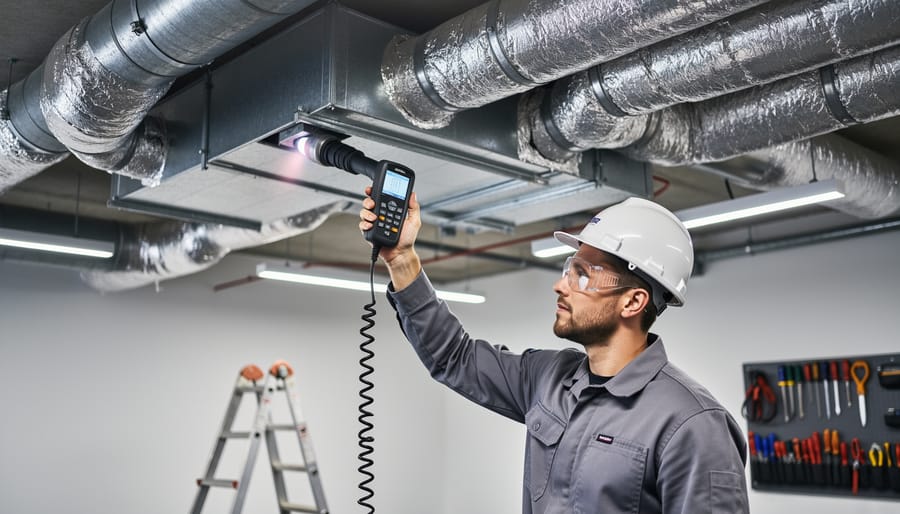
Testing duct leakage requires specialized equipment and a systematic approach that quantifies exactly how much conditioned air escapes from your distribution system. A duct blower test measures this leakage by temporarily sealing all supply and return registers, then using a calibrated fan to pressurize the duct system to 25 Pascals, the standard test pressure that simulates operating conditions. The fan’s airflow rate needed to maintain this pressure, measured in cubic feet per minute (CFM25), reveals total leakage volume.
Professionals distinguish between total duct leakage and leakage to the outside. Total leakage includes air that escapes into conditioned spaces, which still wastes fan energy but doesn’t directly lose heating or cooling. Leakage to outside, air escaping into attics, crawlspaces, or wall cavities, represents the critical energy loss. ENERGY STAR guidelines specify that new homes should have duct leakage to outside below 4 CFM25 per 100 square feet of conditioned floor area, while RESNET standards for existing homes target 6 CFM25 per 100 square feet or less.
Test results directly inform sealing priorities. A home with 2,000 square feet and 180 CFM25 total leakage (9 CFM25 per 100 sq ft) exceeds targets significantly. If 140 CFM25 leaks to outside, sealing becomes cost-effective immediately. The tester maps leak locations using smoke pencils or infrared cameras during the pressurized test, identifying which joints, plenums, or boot connections need immediate attention versus minor seepage that offers diminishing returns on repair investment.
Sealing Techniques: Mastic, Aeroseal, and Mechanical Fasteners
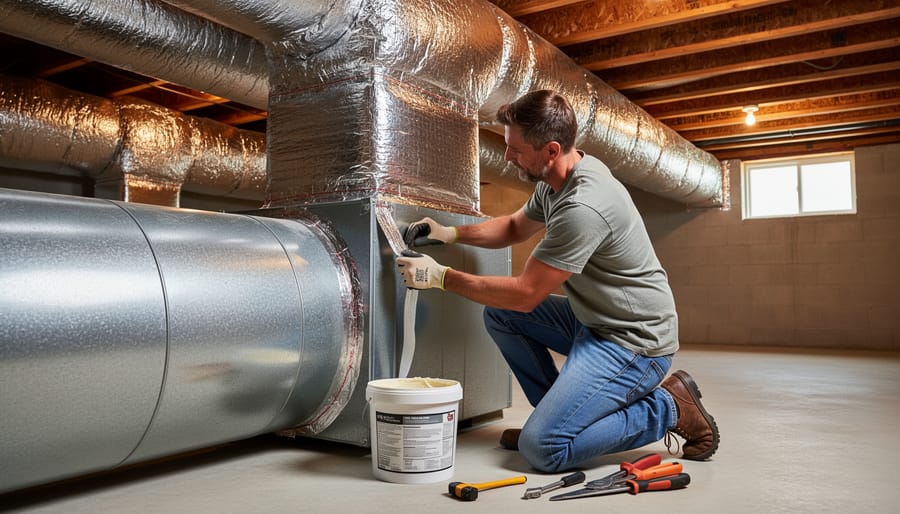
Mastic-and-mesh sealing remains the workhorse method for accessible ductwork: contractors brush a thick, water-based mastic compound onto joints and seams, embedding fiberglass mesh tape for reinforcement on larger gaps. Properly applied mastic creates a flexible, airtight bond that accommodates thermal expansion and contraction, with field studies documenting effective seals lasting 20-30 years. Material costs run $50-150 for a typical single-family system, though labor drives total expenses to $300-800 depending on duct accessibility. Mastic excels on rigid sheet metal ducts and works adequately on flex duct connections, but requires physical access, crawlspaces, attics, and behind finished walls often make thorough hand-sealing impractical.
Aeroseal technology addresses inaccessible leaks by injecting aerosolized polymer particles into pressurized ductwork. The system seals from the inside out: particles accumulate at leak edges where escaping air carries them, building up until gaps close. Automated pre- and post-sealing tests quantify leakage reduction, typically achieving 90% reductions in total CFM25. Professional Aeroseal treatments cost $1,500-3,000, justified when inaccessible leaks dominate or when post-construction sealing is required. The polymer remains flexible but carries a shorter performance history than mastic, manufacturers cite 10-year durability data, with longer-term field performance still emerging.
Mechanical fasteners, sheet metal screws and draw bands, secure duct sections but do not seal air leaks themselves. Foil tape degrades under temperature cycling and loses adhesion within 5-10 years, making it unsuitable as a primary sealant despite its ubiquity in builder-grade installations.
Insulating Ductwork in Unconditioned Spaces
Ducts running through attics, crawlspaces, and garages require R-6 to R-8 insulation to meet current energy codes in most climates. The R-value measures thermal resistance: higher numbers mean better insulation against conductive heat loss. An uninsulated metal duct in a 130°F attic can lose 25-40% of its thermal energy before conditioned air reaches living spaces, even if the duct itself is perfectly sealed.
When adding insulation, proper vapor barrier placement prevents condensation. In cooling climates, place the vapor barrier on the outside of the insulation to keep moist supply air from condensing on cold duct surfaces. In heating climates, reverse this orientation. Failing to match barrier placement to climate creates moisture accumulation inside duct walls, promoting mold growth and degrading insulation performance. Wrap joints completely and secure insulation with drawbands or approved tape, not wire that compresses the material and creates thermal bridges.
Rights and Obligations for Homeowners and Contractors
When you hire a contractor to seal ductwork under a utility efficiency program or state weatherization initiative, both parties assume specific legal responsibilities. Understanding these obligations protects homeowners from substandard work and holds contractors accountable for documented performance improvements.
Homeowners participating in utility rebate programs typically gain the right to post-work verification testing. Most programs require contractors to conduct duct leakage tests before and after sealing, with results reported directly to the program administrator. You can request copies of these test reports, which should show CFM25 measurements and confirm that leakage falls within the program’s target range. Performance guarantees vary by program, but a one-year warranty on workmanship is standard; some utility programs extend coverage to three years.
Contractors must hold appropriate state or local licenses for HVAC or weatherization work, carry liability insurance, and follow building codes that govern duct installation and sealing. They’re obligated to use approved materials, which means mastic and fiber mesh or Aeroseal systems, not foil tape alone. If a contractor participates in an ENERGY STAR or utility-sponsored program, they must complete pre- and post-work testing using calibrated equipment and submit documentation that meets program specifications.
Liability for improper sealing extends beyond wasted rebate dollars. If a contractor seals ducts without addressing combustion appliance zones, negative pressure can pull exhaust gases back into living spaces. Contractors are responsible for conducting worst-case depressurization tests when sealing significantly alters building pressure. Homeowners have the right to refuse work completion until safety tests pass and to demand corrective action if post-sealing problems arise.
If disputes occur, start with the program administrator who approved the contractor. Utility efficiency programs typically maintain quality assurance protocols and can compel contractors to remedy deficiencies. For work outside formal programs, state contractor licensing boards handle complaints about unlicensed operation or code violations, while small claims courts address unresolved warranty claims or documented damages from negligent installation.
Where to Get Help: Official Resources and Professional Networks
Locating qualified professionals and navigating program portals requires knowing where to start and which credentials matter. The RESNET Registry lists certified Home Energy Raters trained in duct diagnostics and whole-home performance testing; search by ZIP code at to find auditors who can conduct blower door and duct leakage tests. The Building Performance Institute (BPI) maintains a contractor directory at, filtering for BPI-certified Building Analysts and Envelope Professionals who understand pressure diagnostics and proper sealing protocols. The ENERGY STAR Partner Locator at provides access to contractors participating in utility rebate programs, though verify current certification status directly with the professional before scheduling work.
State energy offices serve as clearinghouses for local weatherization programs and efficiency incentives. Contact information for all 50 state offices is available through the National Association of State Energy Officials at, with most states offering online rebate application portals that process requests within 30 to 60 days in 2026. Your electric utility’s Demand-Side Management program often bundles duct sealing with renewable energy upgrades, particularly relevant if you’re monitoring solar panel lifespan or addressing inverter troubleshooting as part of a whole-system optimization strategy. Many programs now coordinate efficiency work with solar inverter lifespan assessments to ensure maximum performance across both generation and distribution systems.
- Department of Energy Weatherization Assistance Program:, 1-877-337-3463, income-based eligibility verified through state agencies
- Database of State Incentives for Renewables & Efficiency (DSIRE):, searchable by location and technology, updated monthly with 2026 program changes
- Solar-plus-efficiency lenders: Mosaic (), Dividend Finance (), and GoodLeap () offer combined financing with contractor network access
Most national directories return results within 24 hours of inquiry submission, and state energy office response times average two to three weeks for application reviews. When contacting professionals, request pre- and post-work duct leakage test documentation and verify warranty terms before authorizing any sealing work.
Frequently Asked Questions About Duct and Vent Energy Loss
Can I seal ducts myself?
You can seal accessible duct joints in conditioned spaces using mastic and fiberglass mesh, but professional equipment and training are required to test leakage rates and seal ducts in attics, crawlspaces, or wall cavities. DIY sealing addresses visible leaks but typically misses the majority of losses hidden behind drywall or insulation.
How much will professional sealing cost?
Professional duct sealing ranges from $1,500 to $4,000 for a typical single-family home, depending on system complexity, accessibility, and whether Aeroseal technology is used. Many utility programs cover 50 to 75 percent of the cost through rebates, reducing out-of-pocket expense to $500, $1,200.
Will sealing ducts increase indoor air quality problems?
Properly executed duct sealing improves indoor air quality by preventing unconditioned, contaminated air from attics and crawlspaces from entering the distribution system through return leaks. Contractors must verify adequate mechanical ventilation and combustion appliance safety after sealing to avoid backdrafting or excessive humidity.
How do I know if my efficient home has duct leakage?
Signs include uneven room temperatures, higher-than-expected utility bills despite efficient equipment, excessive dust accumulation, and HVAC systems that run longer cycles than similar homes. A duct blower test conducted by a certified energy auditor quantifies leakage and identifies whether sealing is cost-effective.
What is the payback period for duct sealing in a solar home?
Homes with solar installations typically see payback periods of three to seven years, depending on local electricity rates and initial leakage severity. Sealing reduces the load on HVAC systems, allowing smaller solar arrays to meet total energy needs and improving the return on both investments simultaneously.
Does duct sealing require a permit?
Most jurisdictions do not require permits for duct sealing alone, but any work involving HVAC system modifications, electrical connections, or structural access may trigger permitting requirements. Check with your local building department before starting work, and ensure contractors pull permits when necessary.
Understanding these practical considerations helps homeowners make informed decisions about addressing duct and vent energy losses. The interaction between efficient equipment, renewable energy systems, and distribution system performance requires both technical knowledge and realistic cost-benefit analysis. Professional testing removes guesswork by quantifying losses and prioritizing interventions based on measured results rather than assumptions. Homeowners who approach duct sealing as part of a whole-system efficiency strategy, rather than an isolated repair, achieve better outcomes and faster payback, particularly when coordinating work with solar installations or HVAC replacements.
Even homes equipped with the latest HVAC technology, comprehensive solar arrays, and premium insulation remain vulnerable to a fundamental performance gap: their distribution systems. High SEER ratings and net-zero energy goals mean little when 20-40% of conditioned air never reaches its intended destination. The paradox isn’t a failure of equipment, it’s a failure to address the hidden pathways where energy escapes.
Duct sealing represents one of the most cost-effective interventions available in 2026, often delivering returns that rival or exceed additional solar capacity. Yet many homeowners and solar professionals overlook this essential step, assuming efficiency ends at the equipment nameplate. Testing reveals the truth: leaky ductwork undermines system performance regardless of upstream improvements.
The pathway forward is clear. Professional duct leakage testing quantifies the problem. Certified contractors provide proven solutions. Utility rebates, weatherization programs, and solar-plus-efficiency financing remove cost barriers. Closing this gap transforms theoretical efficiency into measurable energy savings and completes the whole-home performance equation. The tools, incentives, and expertise exist, the question is whether you’ll use them.