7 Questions Researchers Ask About the Wolverine Stack

The Wolverine Stack is a name researchers keep running into, yet verified public documentation on it remains thin, so the safest answer is a careful one: treat every claim as something to confirm against primary sources before you use or cite it. Product pages such as the Kylo wolverine stack listing offer a starting point for definitions, but a vendor page is not peer-reviewed evidence.
That gap matters in solar research. A tool or framework only earns a place in a methods section when its performance data, reproducibility, and licensing terms can be checked independently. The same discipline applies to any component you model or cite, whether you’re estimating degradation curves or weighing solar inverter lifespan assumptions in a techno-economic study.
This article answers seven questions in order: what the Wolverine Stack is, what evidence supports its claims, how reproducible its results are, what data and ethics issues arise, how it compares with alternatives, how it fits into existing workflows, and where its limits lie. Each answer separates what can be verified from what remains open, so you can decide with confidence whether it belongs in your work.
How These Seven Questions Were Chosen
We built this list from the questions researchers raise most often when they evaluate a new tool: what it is, what evidence backs it, whether results can be reproduced, who owns the data, how it compares with alternatives, how it fits existing workflows, and where it falls short. Each candidate was then screened for whether a verifiable, citable source could answer it. The shortlist reflects four criteria:
- The question comes up often in research settings, not just in one-off inquiries.
- It can be answered from documentation, published studies, or named experts.
- It bears directly on study design, from methods to reporting.
- It matters to solar and renewable energy research workflows in practice.
We kept an objective stance throughout. Claims are attributed to documentation, peer-reviewed work, or named experts, and anything we cannot verify is flagged as unverified rather than smoothed over. Where public evidence is thin, we say so plainly. That matters for a tool like this, because a confident answer built on shaky ground does more harm to a research project than an honest gap.
You can apply the same screen yourself. For any claim you read about the Wolverine Stack, ask where it comes from, whether an independent party has confirmed it, and whether you could trace it back to a primary source. If the answer to all three is no, treat the claim as provisional and verify it before it shapes your methods or your citations.
1. What Exactly Is the Wolverine Stack, and Where Does It Fit in Solar Research?
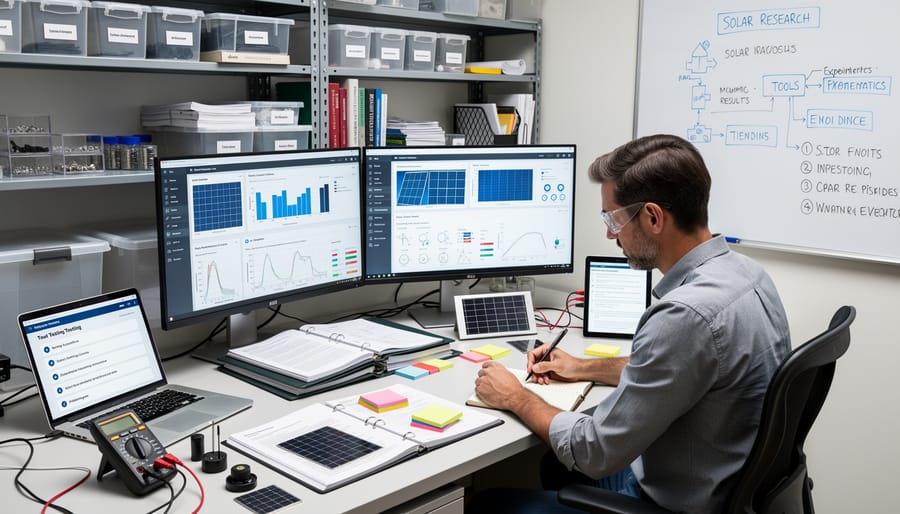
The “Wolverine Stack” is a term researchers use for a layered set of tools, but public documentation is limited, so it helps to separate what is documented from what is assumed.
What can be said with confidence is the general shape. Most research stacks of this kind bundle several layers: data collection (instruments, sensors, or imported datasets), storage and processing (where raw readings are cleaned and organized), and analysis (the models or scripts that turn processed data into findings). The word “stack” simply means these layers are designed to work together rather than as separate, unrelated programs.
What is assumed, and should not be treated as fact without checking the maintainers’ own materials, is the exact list of components, their version history, and any performance claims. If a source does not name a component or cite a test, treat that detail as unverified.
For solar research, the plausible fit is in handling performance data, such as output readings, weather conditions, and equipment status over time. A researcher might use a stack like this to compare system behavior across sites or to flag patterns behind inverter failures for example. That use is an application, not a documented feature, so confirm it against current documentation.
A quick term check: “pipeline” means the ordered steps data passes through, and “workflow” is the broader routine a researcher follows around those steps.
2. What Evidence Supports Its Claimed Performance?
Start with what kind of evidence exists, because not all of it carries equal weight. Peer-reviewed publications sit at the top. Look for studies that describe the stack’s configuration, datasets, and error margins in enough detail that someone else could check them. Independent validation comes next: results from a lab or group with no stake in the stack’s success.
Developer and vendor documentation is useful, but it answers a different question. It tells you what the stack is designed to do, not how well it performs under conditions the developers didn’t choose. Benchmark methodology matters just as much as the benchmark numbers. A headline figure means little without the test conditions, reference data, and comparison baselines behind it.
Here’s the honest picture: for the Wolverine Stack, the public evidence base appears thin. We could not point to a body of independent, peer-reviewed validation, so treat performance claims as provisional until you can trace them to a source you can inspect.
Evaluating emerging tools calls for patience. Reviewers in energy research generally advise weighting a claim by how easily it could be proven wrong: reproducible tests on shared data count for more than a polished results page. If the evidence you need isn’t public, say so in your methods section.
3. How Reproducible Are Results Produced With It?
Reproducibility with the Wolverine Stack depends on two parties doing their part. Maintainers need to publish clear release information, and researchers need to record exactly what they ran. Neither side can carry the whole burden, and public documentation on this stack is limited, so users should assume that a missing detail will not be recoverable later.
Start with versioning. Note the exact release, commit hash, or build identifier you used, not just the product name. A result tied to “the latest version” cannot be checked a year from now.
Next, disclose configuration. Parameter files, default settings you relied on, and any values you changed from those defaults all belong in your records. If a setting was left untouched, say so, because defaults can shift between releases.
Then document the environment. Capture the operating system, dependency versions, hardware used, and any random seeds. A container image or environment lockfile is the simplest way to preserve this.
For your methods section, aim to report:
– The stack version and where it was obtained
– Full configuration and any deviations from defaults
– Software and hardware environment details
– Input data description and preprocessing steps
– Where the code, configuration, and data can be accessed
If the maintainers have not documented one of these items, state that limitation openly. A short note about what you could not verify helps the next researcher more than silence does.
4. What Data Access, Licensing, and Ethics Questions Come Up?

Data access questions usually start with a simple one: who owns the data that goes into the stack, and who owns what comes out? Ownership can sit with the data provider, the developer, the participating institution, or a funder, and the answer often differs for raw inputs versus derived outputs. Check the documentation for a stated position, and where none exists, treat the question as open.
Licensing deserves the same care. Software, datasets, and models may each carry separate terms, covering redistribution, commercial use, attribution, and whether derivative works must be shared under the same conditions. Read each license directly rather than relying on a summary from a forum post or a colleague.
Ethics and compliance questions follow a different track. If your project involves data tied to people, such as household energy use or site-level customer records, your institutional review board or ethics committee may need to weigh in before you start. Many funders and journals also expect data management plans and open-data deposits, which can conflict with restrictive license terms.
None of this amounts to legal advice, and this article does not offer legal conclusions. Confirm terms directly with the source of the data or software, then run your plan past your institution’s research office or compliance team. Save those confirmations in writing, since you may need to cite them in your methods or data availability statement.
5. How Does It Compare With Alternative Approaches?
Comparing the Wolverine Stack with alternatives works best when you treat it as a set of criteria to apply, not a contest with a winner. The right choice depends on your research question, your team’s skills, and the data you already have.
Start with transparency. Can you inspect how the tool processes inputs, and are its assumptions documented well enough to defend in a methods section? Open, auditable components are easier to justify to reviewers than opaque ones.
Next, weigh flexibility. Some approaches are tightly scoped and reliable for a narrow task, while others adapt to varied datasets but demand more configuration. Neither is inherently better. A study with unusual inputs may need the flexible option, whereas a routine comparison benefits from a stable, well-defined one.
Documentation and community support deserve equal attention. Look for maintained guides, clear change logs, and a place to ask questions. Where public documentation is sparse, treat that as a real cost, because it slows onboarding and weakens reproducibility.
Finally, check fit with your existing pipeline. Consider data formats, analysis software, and whether results can flow into the tools your lab already uses without fragile conversion steps.
A simple method helps: score each candidate against these five criteria using evidence you can cite, such as documentation, published studies, or a short pilot run. Record your reasoning so colleagues can follow it, and revisit the comparison as the tools evolve.
6. How Hard Is It to Integrate Into an Existing Research Workflow?
Integration difficulty depends less on the stack itself than on how closely it matches what your lab already does. Start by checking compatibility. Confirm which input and output data formats it reads and writes, and whether your current analysis software can exchange files with it without lossy conversion. If your team studies long-term degradation or PV lifetime for example, time-series formats and timestamp handling are worth testing early, because small mismatches can quietly skew results.
Next, consider skills. Ask who will configure and maintain the stack, and whether they need new training in scripting, containerisation, or version control. Hidden learning curves often cost more time than the software itself.
Computing requirements deserve a realistic look too. Check memory, storage, and processing needs against the hardware or institutional cluster you actually have access to, and find out whether cloud or shared resources are permitted for your data.
Before committing to a full study, run a pilot on a small, well-understood dataset. Compare its outputs against results you already trust, record every setting, and note where friction appears. A short pilot exposes format problems, skill gaps, and resource limits while they are still cheap to fix.
7. What Are the Known Limitations and Open Questions?
No tool in a fast-moving research area arrives without gaps, and the Wolverine Stack is no exception. Researchers should state its limitations openly in their methods and discussion sections, because readers cannot judge a result without knowing where the tool’s reach ends.
Three areas deserve explicit disclosure. First, scope boundaries: say which tasks, datasets, and conditions you actually tested, and avoid implying wider applicability. Second, validation gaps: note whether your results were checked against an independent reference or only against the developers’ own materials. Third, open questions about long-term behaviour. If your work touches on performance over time, for example in studies connected to solar panel lifespan be clear about the time horizon your data really covers.
Independent study is still needed wherever public evidence is thin. If you have findings, replication attempts, or critiques, we welcome contributions from researchers and academic institutions, and expert input is always appreciated.
Quick Answers to Follow-Up Questions Researchers Raise
Not every question needs a full section. These come up often enough that a direct answer saves time.
Start with the primary documentation maintained by the developers, then check whether any independent publications describe or test the stack. Treat anything you cannot trace to a named source as unverified until you confirm it.
Where should I look for documentation?
Begin with the official repository or project pages, including any readme files, release notes, and change logs. If those are sparse, say so in your methods rather than relying on third-party summaries.
How do I cite the Wolverine Stack?
Follow your journal’s or institution’s style guide, and include the name, the exact version or release you used, the access date, and the URL or repository identifier. If the maintainers publish a preferred citation, use that form.
How should I evaluate claims I find online?
Ask who made the claim, whether it was independently tested, and whether the method is described well enough to repeat. Claims without a traceable source should be flagged, not repeated.
How do I ask maintainers for clarification?
Use the project’s official channel, such as an issue tracker or listed contact address. Describe your goal, your configuration, and the specific behavior you are trying to understand, so the reply can be precise.
When you do get an answer, record it with the date and the channel it came from. That small habit makes your work easier to defend and easier for others to follow later.
Final Takeaway: Evaluating the Wolverine Stack With Confidence
Start with the research question, not the tool. Before adopting the Wolverine Stack, decide what you need it to do, then weigh the evidence behind its claims, separating independent validation from self-reported results. Document versions, configurations and environments so others can reproduce your work, and state limitations plainly in your methods and discussion. Where public documentation is thin, say so rather than filling the gap with assumptions. That habit protects your findings and makes them easier for peers to trust, cite and build on. If you want to keep exploring, the site’s other coverage of research tools and methods in solar energy offers further context for evaluating emerging technologies with the same care.