What Is CEA Solar (and How Does It Work)?
CEA systems typically achieve higher conversion efficiency in direct sunlight conditions, often reaching 25-30% compared to conventional PV’s 15-22%.

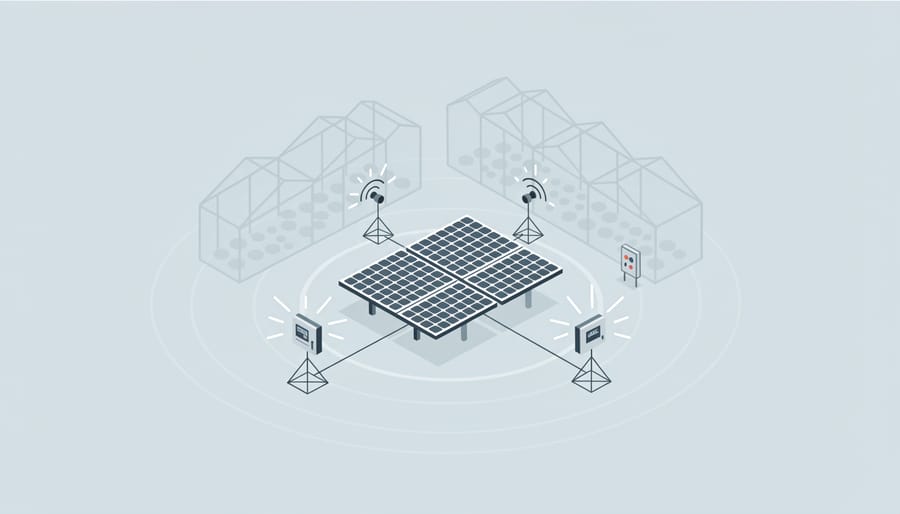
CEA solar refers to Controlled Environment Agriculture systems powered by photovoltaic technology, integrating renewable energy generation with precision farming infrastructure to support year-round food production in enclosed spaces such as greenhouses, vertical farms, and indoor growing facilities. This hybrid approach combines solar panels with climate-controlled agricultural environments, addressing the substantial energy demands of artificial lighting, HVAC systems, and automated controls that define modern CEA operations.
The significance of CEA solar extends beyond simple cost reduction. Commercial CEA facilities can consume 10 to 100 times more energy per square meter than traditional field agriculture, with electricity representing up to 60 percent of operational expenses in vertical farms. Solar integration directly tackles this economic barrier while improving sustainability metrics that increasingly influence market access and investor confidence. For solar professionals evaluating CEA projects, understanding the interplay between energy generation capacity, facility load profiles, and equipment durability becomes essential to project viability.
This article examines how CEA solar systems function, the specific components that differentiate them from standard commercial solar installations, and the operational considerations that affect long-term performance. Durability questions naturally arise given the harsh growing environments where panels and inverters must operate. High humidity, temperature fluctuations, and potential exposure to agricultural chemicals create conditions that test equipment beyond typical commercial rooftop scenarios. The solar panel lifespan in these applications depends heavily on installation design, component selection, and maintenance protocols tailored to agricultural settings.
Understanding CEA Solar Technology
CEA solar technology represents a distinct approach within the concentrated solar power (CSP) family, designed to maximize energy capture by focusing solar radiation onto receiver systems rather than converting sunlight directly through photovoltaic cells. The fundamental principle involves using reflective surfaces or lenses to concentrate sunlight, often achieving intensities hundreds of times greater than ambient solar radiation. This concentrated energy generates heat, which then drives thermal engines or chemical processes to produce electricity.
The core distinction from conventional photovoltaic systems lies in the conversion pathway. Standard PV panels transform photons into electrical current through semiconductor materials in a single-step process, whereas CEA solar operates as a two-stage system: first concentrating thermal energy, then converting that heat into power. This approach allows CEA installations to incorporate thermal storage, enabling electricity generation after sunset, a capability that standard PV systems cannot match without expensive battery banks. The concentration factor also means CEA systems achieve higher thermodynamic efficiencies at scale, particularly in regions with high direct normal irradiance.
- Direct Normal Irradiance (DNI)
- The amount of solar radiation received per unit area by a surface perpendicular to the sun’s rays, excluding scattered light. CEA systems require high DNI levels to operate efficiently.
- Thermal Storage Medium
- Materials such as molten salts that store concentrated heat energy for hours or days, allowing power generation when sunlight is unavailable.
- Concentration Ratio
- The factor by which solar radiation intensity increases at the receiver compared to ambient sunlight. CEA systems typically operate between 100× and 1,000× concentration.
- Heat Transfer Fluid
- The working medium that carries thermal energy from the receiver to the power conversion system or storage tanks, often specialized oils or molten salts.
Unlike Joule solar and other photovoltaic technologies that perform best with diffuse light and cooler temperatures, CEA solar thrives in desert environments with minimal cloud cover and consistent direct sunlight. The technology demands precision tracking systems to maintain optimal alignment with the sun throughout the day, adding mechanical complexity but enabling sustained high-temperature operation. This thermal pathway allows integration with existing power plant infrastructure and creates opportunities for hybrid systems that combine solar concentration with conventional fuel sources, smoothing the transition to renewable energy while maintaining grid reliability.
How CEA Solar Systems Operate
Energy Capture and Concentration
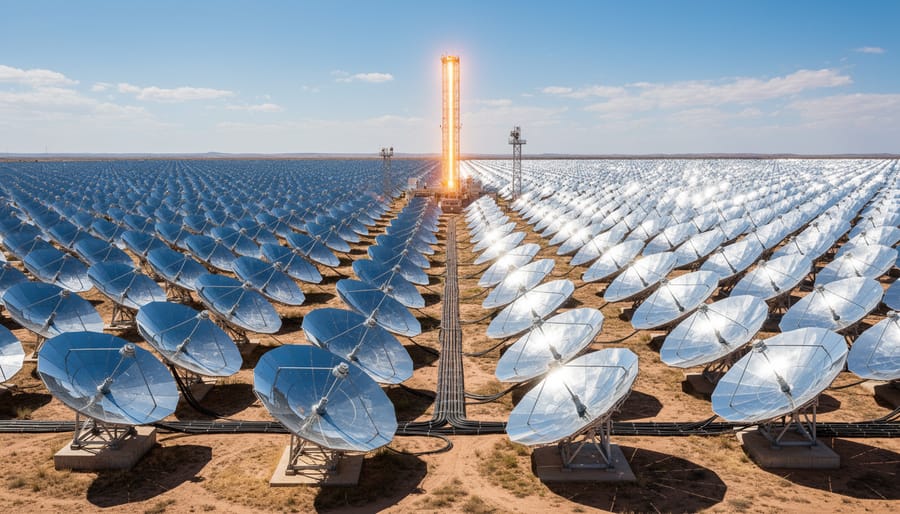
CEA solar systems employ specialized optical elements to capture and intensify incoming solar radiation before conversion. Unlike flat-plate photovoltaic panels that absorb diffuse sunlight across their entire surface, CEA configurations use mirrors or lenses to redirect and focus solar rays onto a smaller, more efficient receiver area. This concentration multiplies the energy density striking the receiver, often achieving ratios between 10:1 and 1000:1 depending on system design.
The capture mechanism typically relies on parabolic mirrors, Fresnel lenses, or heliostat arrays that track the sun’s movement throughout the day. Two-axis tracking systems follow both the sun’s elevation and azimuth, maximizing radiation interception from dawn to dusk. Single-axis trackers, though less precise, offer simpler mechanics for east-west solar movement.
Once collected, the concentrated beam directs thermal energy or intense light onto receivers designed for high-flux conditions. In thermal CEA systems, this heat transfers to a working fluid, molten salt, synthetic oil, or pressurized water, that reaches temperatures exceeding 500°C. Photovoltaic CEA variants focus light onto multi-junction cells engineered to handle concentrated irradiance without degrading.
The concentration ratio directly influences both system efficiency and component stress. Higher ratios demand more precise alignment and impose greater thermal loads on receivers, affecting long-term material stability. Proper optical calibration and surface cleanliness prove critical: even minor soiling on mirrors or lenses can reduce concentration effectiveness by 5-15%, compromising the energy gain that justifies the system’s complexity.
Conversion and Distribution
Once concentrated solar radiation reaches the receiver, it heats a working fluid, typically synthetic oil, molten salt, or water, to temperatures often exceeding 400°C. This thermal energy transfer represents the critical conversion stage where optical energy becomes heat energy ready for power generation.
The superheated fluid flows through a heat exchanger that produces high-pressure steam. This steam drives a conventional turbine-generator assembly, converting thermal energy into mechanical rotation and subsequently into electrical power through electromagnetic induction. Modern CEA systems achieve conversion efficiencies between 20-30%, with thermal storage capabilities that extend generation beyond sunlight hours.
Distribution follows standard power grid protocols. Generated electricity feeds into transformers that step voltage up to transmission levels, typically 115-500 kV for utility-scale installations. From there, power enters the regional grid infrastructure where it’s distributed to industrial facilities, commercial operations, or residential areas through substations that step voltage down to usable levels.
Many CEA plants incorporate thermal energy storage systems that hold heated fluid in insulated tanks. This stored thermal mass allows continued electricity generation for 4-15 hours after sunset, addressing intermittency concerns inherent to solar technologies. The storage component significantly enhances plant capacity factors, some installations achieve 40-50% annual capacity compared to 15-25% for standard photovoltaic systems without storage.
Control systems monitor fluid temperatures, flow rates, and pressure levels throughout the conversion cycle, automatically adjusting pump speeds and valve positions to maintain optimal operating parameters and prevent component stress that could compromise equipment longevity.
Core Components of CEA Solar Systems
CEA solar systems rely on precision-engineered components that work in concert to capture, concentrate, and convert solar energy. Each element plays a critical role in system performance and long-term reliability.
The primary concentrator assembly forms the heart of CEA installations. These optical systems, typically parabolic mirrors, Fresnel lenses, or heliostat arrays, redirect and intensify solar radiation onto a focal point. Concentrator surfaces require high reflectivity coatings, often aluminum or silver-based, applied to glass or polymer substrates. The geometry varies by design: parabolic troughs create a linear focus, while dish concentrators produce a point focus achieving concentration ratios exceeding 1,000 suns.
Receivers sit at the focal point where concentrated light energy converts to heat. In thermal CEA systems, receivers contain heat transfer fluid flowing through absorber tubes, typically constructed from stainless steel or specialized alloys with selective coatings that maximize absorption while minimizing thermal radiation losses. High temperatures at the receiver, often 300°C to 800°C depending on the design, demand materials resistant to thermal cycling and oxidation.
The tracking mechanism ensures concentrators maintain optimal alignment with the sun throughout the day. Single-axis trackers follow the sun’s east-west movement, while dual-axis systems adjust for both azimuth and elevation. Tracking drives incorporate motors, gearboxes, and position sensors controlled by programmable logic systems. Accuracy matters: even a 1-degree misalignment can reduce output by 5 percent or more in high-concentration designs.
Heat exchangers transfer thermal energy from the receiver circuit to the power generation system or thermal storage. Shell-and-tube or plate-type exchangers must withstand high temperatures and pressure differentials while maintaining efficiency over decades of operation.
Control systems monitor and coordinate all components. Sensors track solar position, fluid temperatures, flow rates, and system pressures. Controllers adjust tracking angles, regulate flow rates, and implement safety protocols during overheating or equipment faults. Modern installations integrate SCADA systems for remote monitoring and predictive maintenance algorithms.
Thermal storage tanks, when included, hold molten salts or other heat transfer media at temperatures above 300°C, extending operation beyond daylight hours. Tank insulation and containment materials must prevent heat loss while resisting corrosion from storage media over 20-plus year operational lifespans.
Applications and Use Cases
CEA solar technology excels in applications where high-temperature heat or concentrated energy streams deliver clear operational advantages over standard photovoltaic arrays. Industrial facilities with substantial thermal energy demands, such as chemical processing plants, refineries, and metal production operations, deploy CEA systems to generate process heat at temperatures ranging from 400°C to over 1000°C. These installations reduce fossil fuel consumption while leveraging durable reflective surfaces and receiver assemblies designed for decades of continuous service.
Utility-scale power generation represents another major deployment sector. Large concentrating solar power (CSP) plants use CEA principles to drive steam turbines, storing excess thermal energy in molten salt reservoirs or pairing with sand battery storage systems to extend electricity production beyond daylight hours. These facilities typically occupy hundreds of acres in high-direct-normal-irradiance regions, where consistent sunlight ensures optimal energy capture and justifies the upfront investment in long-lived receiver components and tracking infrastructure.
Primary sectors where CEA solar delivers peak performance include:
- Enhanced oil recovery operations requiring sustained steam generation
- Desalination plants converting seawater through thermal distillation processes
- Food processing facilities needing pasteurization and sterilization heat
- District heating networks serving multiple commercial or residential buildings
- Mining operations using concentrated heat for ore processing
Commercial installations target applications where thermal consistency and equipment longevity outweigh higher capital costs. Hospitals, universities, and manufacturing campuses integrate CEA arrays to offset natural gas consumption for heating, cooling via absorption chillers, and cogeneration systems. The modular nature of many CEA designs allows phased expansion as energy demand grows, with individual collector units replaced or upgraded without dismantling entire arrays. Maintenance schedules focus on cleaning reflective surfaces and inspecting receiver tubes, tasks that preserve system efficiency and extend operational life well beyond 25 years when properly executed.
CEA Solar Equipment Durability and Lifespan
CEA solar systems typically deliver 25 to 30 years of productive service when properly maintained, though component-level durability varies significantly across the installation. The optical concentration elements, mirrors or lenses, face continuous exposure to environmental stressors including UV radiation, thermal cycling, and particulate accumulation that can degrade reflective coatings over time. Field data shows reflectivity losses of 0.5 to 1.5 percent annually in harsh climates, directly impacting energy capture efficiency and requiring periodic resurfacing or replacement around the 15-year mark.
Thermal receivers and heat transfer components experience more intensive wear than standard photovoltaic lifetime components due to operating temperatures that routinely exceed 400°C in high-concentration systems. Thermal expansion stress, corrosion from heat transfer fluids, and seal degradation represent the primary failure modes. Proactive inspection protocols every 12 to 18 months help identify early-stage corrosion or fluid leaks before they cascade into system-wide performance losses.
Tracking mechanisms and mounting structures require regular lubrication and alignment verification, as precision deteriorates with mechanical wear. Tracking errors as small as 2 degrees can reduce energy output by 10 to 15 percent in concentrated systems, making quarterly calibration checks standard practice at well-managed installations. Control electronics and power conversion equipment follow degradation patterns similar to conventional solar plants, with inverter failures occurring most frequently in the 10 to 12-year window.
Environmental conditions dramatically influence longevity outcomes. Coastal installations contend with salt corrosion accelerating component wear, while desert sites face abrasive dust requiring more frequent cleaning cycles and protective coating renewal. Systems in moderate climates with established maintenance protocols consistently achieve the upper end of expected lifespan ranges, whereas installations neglecting preventive care often see 20 to 30 percent performance degradation within the first decade.
How Cea Solar Works
At its core, CEA solar operates through a coordinated sequence that transforms concentrated sunlight into electricity. The process begins when tracking mirrors or lenses follow the sun’s path across the sky, continuously adjusting their position to maintain optimal alignment. These reflective or refractive surfaces redirect incoming solar radiation toward a central receiver, multiplying the energy density by factors ranging from 100 to 1,000 times normal sunlight intensity.
The concentrated beam heats a transfer medium, typically molten salt, synthetic oil, or water, to temperatures exceeding 400°C (752°F). This thermal energy drives a conventional power generation cycle. In most configurations, superheated steam spins turbines connected to generators, producing grid-compatible electricity through the same proven technology used in fossil fuel plants.
What sets this process apart is its thermal storage capability. Excess heat captured during peak sunlight hours gets stored in insulated tanks, allowing electricity generation to continue after sunset or during cloudy periods. This buffer distinguishes CEA systems from direct photovoltaic arrays, which cease production when sunlight fades. The entire cycle, from solar tracking to power delivery, runs under automated control systems that optimize concentration angles and manage thermal loads throughout daily and seasonal variations.
Common Questions About CEA Solar
Professional buyers and engineers evaluating CEA solar systems often need specific performance and economic data before committing to large-scale deployments. The following addresses the most frequent technical and commercial inquiries that arise during procurement and planning phases.
How does CEA solar efficiency compare to traditional photovoltaic systems?
CEA systems typically achieve higher conversion efficiency in direct sunlight conditions, often reaching 25-30% compared to conventional PV’s 15-22%. However, this advantage diminishes in diffuse or cloudy conditions where standard panels maintain more consistent output.
What maintenance requirements should facilities plan for?
Regular cleaning of optical components is critical, as dust accumulation severely impacts concentration effectiveness. Most installations require monthly cleaning schedules and annual calibration of tracking systems, with component inspection every six months.
Is CEA solar cost-effective for smaller commercial installations?
CEA systems generally become economically viable at larger scales, typically above 500 kW capacity. Smaller installations often face unfavorable economics due to high initial equipment costs and maintenance requirements that don’t scale proportionally.
What operational lifespan can operators expect from CEA equipment?
Well-maintained CEA systems demonstrate operational lifespans of 20-25 years for core components, with tracking mechanisms and optical elements requiring replacement or refurbishment around the 15-year mark. Performance degradation follows a different curve than conventional PV, with more abrupt declines if optical surfaces deteriorate.
Site assessment remains crucial since CEA technology demands specific environmental conditions. Locations with high direct normal irradiance, minimal cloud cover, and low dust levels deliver the best return on investment. Projects in regions with frequent haze or particulate pollution face accelerated maintenance cycles that erode economic advantages. System integrators should also evaluate grid infrastructure, as CEA installations often produce power in concentrated patterns that may require upgraded transmission capacity during peak generation periods.
CEA solar technology represents a meaningful evolution in concentrated solar energy systems, offering distinct operational advantages through its approach to energy capture and conversion. The technology’s ability to achieve higher efficiency rates through concentration mechanisms positions it as a viable option for utility-scale and industrial applications where space optimization and energy density matter.
From a longevity perspective, CEA systems demonstrate competitive lifespans when properly maintained, with key components designed for 20-25 year operational cycles. The durability of tracking systems, reflective surfaces, and heat transfer components directly influences overall system performance and return on investment. Regular maintenance protocols and quality component selection significantly extend functional life while minimizing degradation rates.
As the solar industry continues advancing toward higher efficiency benchmarks and improved durability standards, CEA technology contributes valuable insights into thermal management, materials engineering, and system integration. For professionals evaluating concentrated solar options, understanding CEA’s operational principles, component requirements, and maintenance demands enables informed decision-making aligned with specific project parameters and long-term performance goals. The technology’s ongoing development reflects broader industry trends toward optimized energy capture and sustained equipment reliability.